
Kodiak Island Mountain Goat Hunting Dates and Rates:
$14,500 Mountain Goat Hunt Cost
Optional add ons:
Sitka blacktailed deer add- On- $5500
Observer - $4500
Personal Packer (recommended) - $3600
Additional Required Expenses (Not Included)
The following costs are required and paid directly by the hunter:
- Alaska hunting license and goat/deer locking tag/s
- Required transportation to and from the hunting area
- Applicable third party land access fess
- Gratuities for guides and staff (customary but not required)
Certain land access fees are assessed by third party landwoners and permitting entities and are subject to change annually. These fees are not retained by the outfitter.
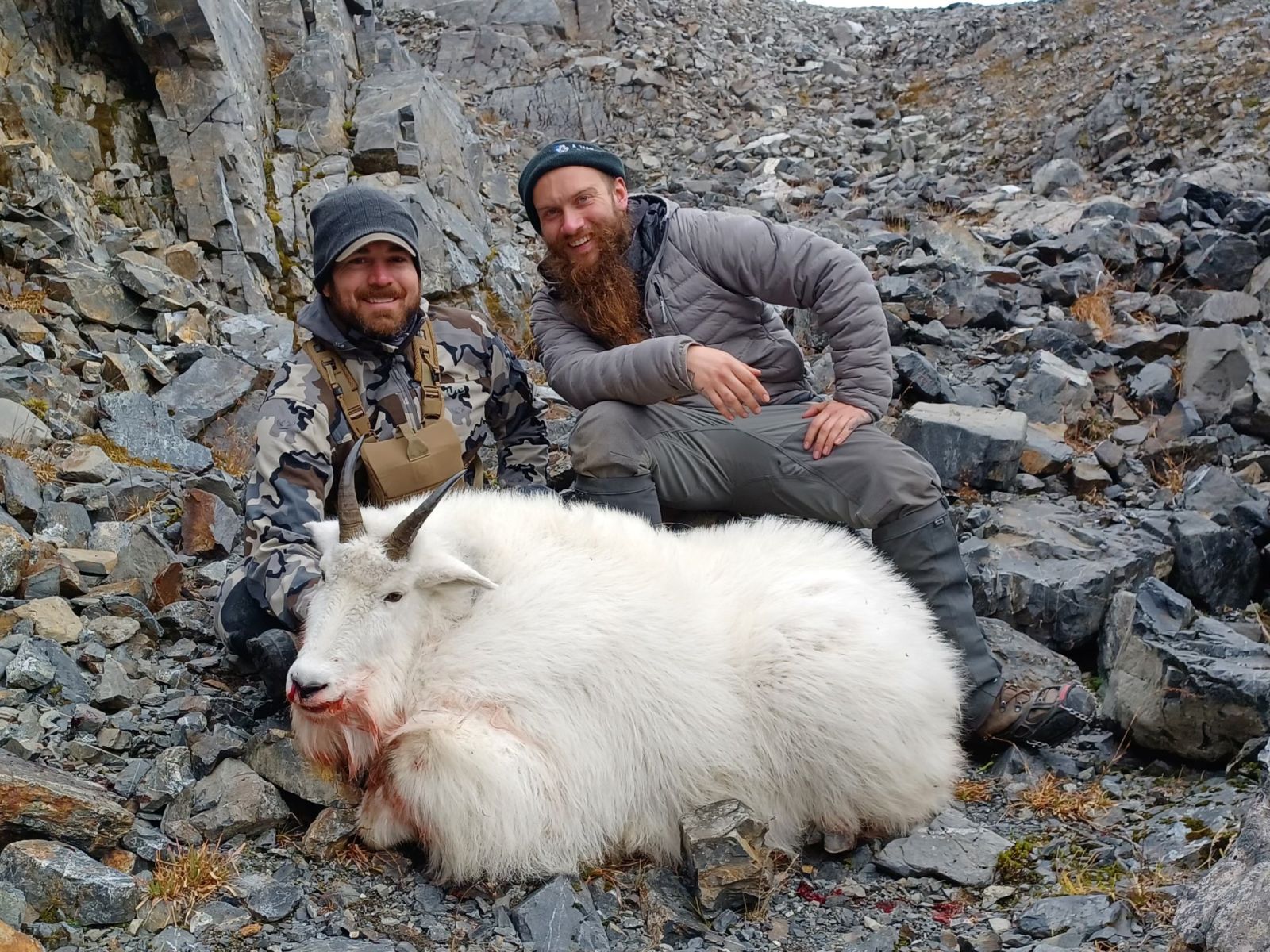
The Kodiak mountain goat (Oreamnos americanus) is the only North American representative of the goat-antelope lineage within the Caprinae subfamily, specifically classified among the rupicaprines, a group of highly adapted mountain ungulates often referred to as “rock goats.” As the name implies the goats on Kodiak Island have found the rocks! It is a home that suits them very well.
Kodiak’s geography consists of jagged, steep mountains, rugged rock faces, and deep canyons that descend to sea level. In general, it is a place that transitions from ocean to alpine terrain. This diverse landscape provides mountain goats with excellent escape terrain during spring, summer, and fall, as well as outstanding winter habitat.
High alpine overhangs and meadows offer abundant grazing, while many areas of the island remain difficult for humans to access. This combination of factors has significantly contributed to the success and expansion of Kodiak’s mountain goat population.
.jpg)
BOOK YOUR ALASKAN
MOUNTAIN GOAT HUNT TODAY!
CALL: 907-654-5378
Campbell’s mountain goat hunts are conducted through Alaska’s draw system. Drawing odds fluctuate from year to year, but it is generally expected that hunters will receive a tag within approximately three years. In many cases, first-time applicants are successful.
The draw application period runs from November through early December. Prior to applying, hunters are required to sign a contract with Campbell’s High Caliber Guide Service, submit a deposit, and purchase an Alaska big game hunting license for the applicable year. Once prepared, Campbell’s will enter the hunter into the draw (application fee: $30). Results are typically released in mid-February. Mountain goat season runs from August 20 through October 25, with most hunts occurring mid-October to ensure optimal hide quality.
Hunters should plan for seven full days of hunting, plus travel days on each end. Clients can expect to spend one day traveling to the town of Kodiak, where an overnight hotel stay is required. The following day, tags can be picked up and bought in the City of Kodiak prior to field transport.
Once transported into the field, the focus quickly turns to the hunt. Hunters will immediately begin hiking toward goat habitat. Spike camp, optics, and nine days worth of food will be provided. Hunters are responsible for bringing their own sleeping bags. It is strongly recommended that gear lists be kept as light as possible. Mountain goat hunting often involves a degree of “earned hardship” in exchange for access to extreme terrain.
Kodiak Island’s alpine environment is steep, rugged, and breathtakingly beautiful. Goats frequently inhabit the most challenging terrain on the mountain. Physical fitness is essential, and hunters should have full confidence in their legs and balance before pursuing a mountain goat hunt. Microspikes, crampons, and trekking poles are recommended to assist with steep and unstable slopes.
Patience is often required. At times, a mature billy may be located in inaccessible terrain or positioned above hazardous drop-offs. In these situations, hunters may need to wait for the animal to move into a safer position or continue glassing alternative areas. Goat populations are strong, and opportunities are often available with proper patience and decision-making.
At Campbell’s, we prioritize ethical shot placement and recovery. Mountain goats are especially vulnerable to falling into unrecoverable terrain if wounded. Hunters should be confident in their weapon system and prepared for follow-up shots if needed. Our goal is to keep shots within 350 yards whenever possible.
Once a goat is harvested and processed, the climb out begins. Mountain goat meat is excellent table fare, and all edible meat is recovered from the field. Meat can be shipped home or donated locally.
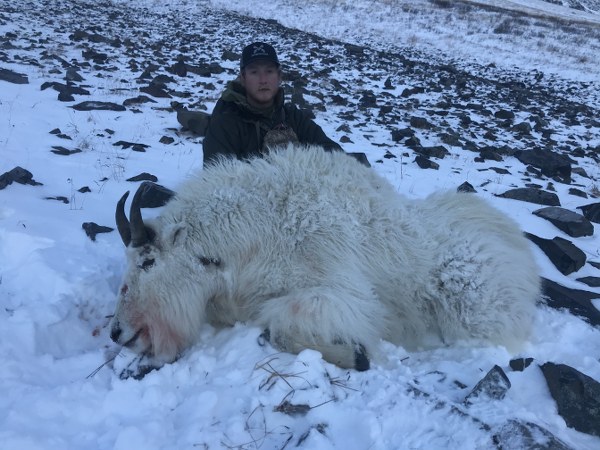
Mature billies make exceptional trophies. Full-body mounts are striking, showcasing their long white hair, beards, and distinctive pantaloons. Half-body mounts and rugs are also popular options. Mountain goat hunts often create memories that last generations, and Campbell’s High Caliber Guide Service is proud to play a role in that experience.
Another thing to consider is combining a Sitka black tail deer hunt with your goat hunt. Often times trophy bucks can be found. Understand though, the goat tag must be drawn where as a deer tag is over the counter and can be hunted any year.
Goat hunting is all about a balance between comfort and misery. Regardless of how good of shape your in every pound/ounce you can leave at the bottom of the mountain and still be warm will be appreciated and make the experience more enjoyable. This list is what you carry up the mountain in your pack. I also have a general list on the info page of our website. Once we head up the mountain we will not be coming back until the hunt is concluded, so what you have in your pack is what you got.
Recommended Mountain Goat Gear List:
• Sleeping bag: I currently use a 15-degree Kuiu bag. Regardless of brand, ensure your bag compresses well and fits efficiently in your pack. I caution against using anything rated lighter than 20 degrees.
• Sleeping pad: I currently use a Therm-a-Rest NeoAir Xlite. Air pads provide excellent insulation but carry some risk of puncture compared to foam pads. This is a risk I am willing to take.
• Rain gear: I currently use a First Lite no-storm shelter. It is lightweight and effective. Any quality rain gear will work; seams are typically the first area to fail, so ensure durability.
• Insulation layers: Lightweight, high-warmth jacket and pants. Synthetic insulation is commonly used. Make sure pants can be put on and removed without removing boots.
• Hiking pants: I currently use Stone Glacier. Other quality brands such as Kuiu and Sitka also perform well. Avoid cotton clothing.
• Base layers: Two base layers for both top and bottom. I prefer merino wool. One lighter set and one heavier set are ideal. Sleep in clean layers and rotate them as needed.
• Socks: Two pairs of heavy wool socks and four pairs of synthetic liner socks. A waterproof sock can be useful if boots become soaked (optional).
• Gaiters: Optional, but recommended.
• Boots: A high-ankle hiking boot is critical. I prefer leather. Brands such as Meindl, Kenetrek, and Crispi are good options. Boots should be broken in with at least 50 miles prior to the hunt.
• Backpack: A quality pack with approximately 5,000 cubic inches of capacity. I use a Barney’s Sports Chalet external frame pack, though many hunters prefer internal frames. Look for strong waist and shoulder straps and durable buckles.
• Optics: 10x binoculars work well.
• Toiletries: Toothbrush and sunscreen stored in a zip-lock bag.
• Headwear: Hat for sun and weather protection.
• Gloves: Lightweight hiking gloves and a warmer insulated pair. Wool liners work well.
• Headlamp
• Rifle
• Water bottle
• Waterproof pack cover: Keep pack contents dry. Compression dry bags are recommended for sleeping bags and insulation layers.
• Floatplane access: Hunters will be getting on and off a floatplane. Waders can be provided, or hunters may bring their own.
• Optional: A change of clothes left at the bottom of the mountain for after the hunt.
Physical conditioning is important. Hunters should maintain a solid fitness routine that includes cardiovascular training prior to the hunt.